The Suburban Spectrum Land Grab: What FWA Means for Your Redundancy Strategy
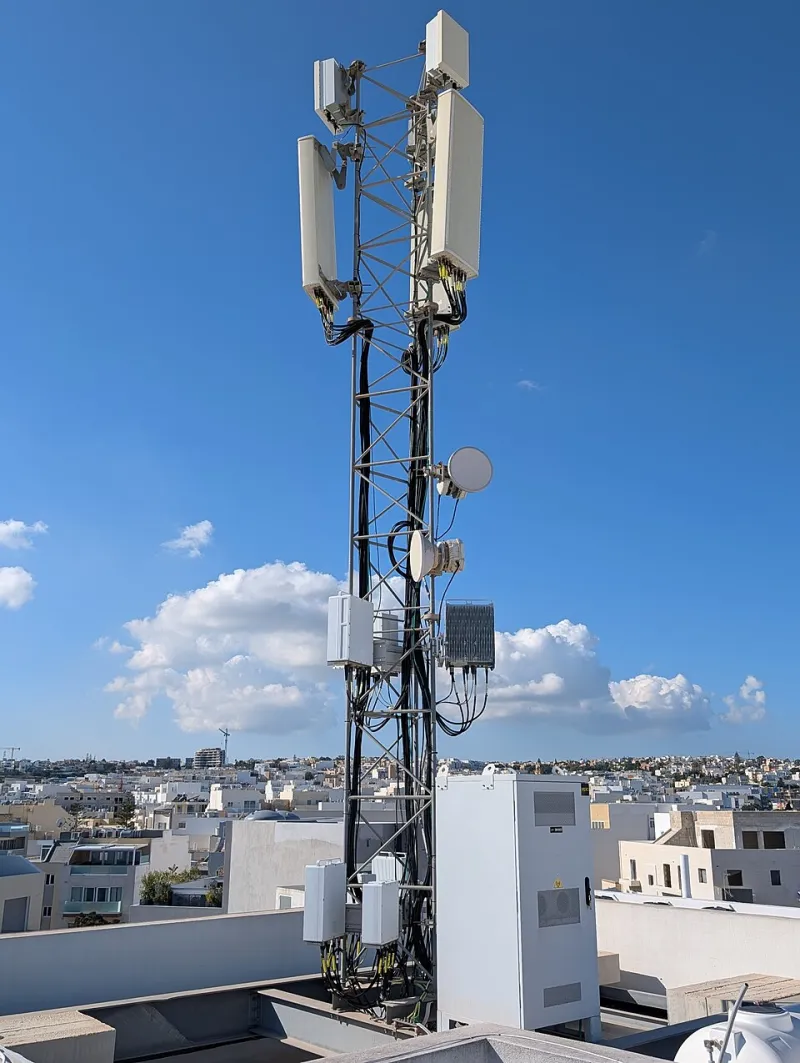
Photo: Marcin Floryan, CC BY 4.0, via Wikimedia Commons
For most of the broadband era, the American suburb offered exactly two last-mile options: the cable company and, if you were lucky, the telco. That duopoly is now facing a third entrant with national scale, licensed spectrum, and a compelling pitch — no trenching, no truck roll, no twelve-month construction wait.
Fixed wireless access, delivered over 5G networks from Verizon, T-Mobile, and AT&T, has moved from novelty to mainstream in under three years. According to industry tracking, the three carriers collectively added millions of FWA subscribers across suburban and exurban markets, with T-Mobile alone crossing the five-million-customer mark for its 5G Home Internet product. For network architects, the disruption is worth watching — not because FWA will replace fiber, but because it changes the calculus of last-mile redundancy.
How the Technology Actually Works
FWA is not the fixed wireless of the 1990s, and it is not Wi-Fi extended over a neighborhood. It is essentially a cellular connection terminated at a customer-premises router: the same 5G radio network serving smartphones delivers broadband to a fixed address, typically using mid-band spectrum in the 2.5 GHz (n41), 3.45 GHz (n77), and C-band ranges.
The economics hinge on capacity, not coverage. T-Mobile leans heavily on its 2.5 GHz holdings; Verizon's FWA push is anchored in C-band, which it spent tens of billions acquiring in the 2021 auction; AT&T's Internet Air rides its mid-band build-out. Because a single sector can serve dozens of homes, carriers can offer the service wherever macro-cell capacity exists — which is why suburban markets with strong 5G build-outs saw FWA arrive first.
Millimeter-wave plays a role in dense deployments, but the workhorse is mid-band: a pragmatic balance of range and throughput that lets carriers light up entire subdivisions from existing towers.
Advertised Speeds vs. the Driveway Test
Marketing materials for FWA commonly advertise "up to" speeds in the 100–400 Mbps range. Real-world performance tells a more nuanced story.
Independent measurements and user reports consistently show a wide band of outcomes. A well-sited C-band connection in a suburban Dallas cul-de-sac might sustain 300+ Mbps during evening prime time. A 2.5 GHz connection at the edge of a tower sector in exurban Atlanta might struggle past 80 Mbps when the neighborhood logs on at 7 p.m.
Three factors dominate the variance:
- Sector congestion. FWA capacity is shared across all subscribers on a cell sector. Unlike DOCSIS, where congestion is managed with node splits, FWA carriers throttle new subscriber intake in congested areas — a de facto admission-control policy that can mean waitlists in popular zip codes.
- Signal quality at the install point. Indoor self-install gateways are the norm. Homes at the fringe of a sector, or with dense construction, see materially lower throughput than the same plan a quarter-mile closer to the tower.
- Weather and foliage. Mid-band propagates reasonably well, but heavy rain and summer foliage introduce measurable attenuation, particularly at C-band frequencies.
Latency is generally respectable — 20 to 40 milliseconds is typical — though jitter is higher than fiber and can matter for real-time enterprise applications.
Why Enterprise Planners Should Care
The instinctive enterprise reaction to FWA is dismissal: consumer-grade, best-effort, no SLA worth the paper. That instinct is half right and increasingly half wrong.
The case for FWA in the enterprise WAN is as a tertiary or secondary path, not a primary circuit. Consider the standard suburban branch: a fiber or cable handoff, plus a wireless backup. Historically that backup was an expensive licensed microwave link or a metered LTE connection with throughput measured in tens of megabits. FWA changes the math — an unlimited or high-cap wireless backup at consumer pricing can now carry a branch through a fiber cut for days, not hours.
SD-WAN makes this practical. Modern edge platforms can steer traffic across a cable primary and an FWA backup with application-aware policies, keeping voice and critical SaaS on the stable path while bulk traffic rides the wireless link. For retail chains, healthcare clinics, and distributed financial services offices — precisely the suburban footprints where FWA is strongest — the economics are hard to argue with.
The Risks Worth Naming
Caveats apply, and they are not trivial:
- Capacity is not contracted. FWA plans carry no throughput guarantees. A carrier can deprioritize or throttle the service, and network upgrades follow consumer demand, not your branch's Q4 requirements.
- Coverage maps lie at the parcel level. A strong signal at the street corner says nothing about the office suite behind the building. Always validate with a trial install.
- CGNAT is standard. Most FWA deployments sit behind carrier-grade NAT, complicating inbound connections and some security architectures. Plan for outbound-only designs or overlay tunnels.
A Third Rail Becomes a Real Option
The suburban broadband map is no longer a two-lane road. Cable operators are responding with aggressive pricing and multi-gig DOCSIS 4.0 rollouts, fiber overbuilds continue in attractive markets, and FWA has inserted genuine competition into zip codes that saw neither for twenty years.
For the enterprise network team, the takeaway is procedural rather than dramatic: revisit branch redundancy templates, price FWA into failover designs, and treat the suburban last mile as a competitive market rather than a captive one. The arms race is between carriers — but the ammunition, increasingly, benefits the buyer.