A Million Square Feet, One Controller: Inside the Private 5G Buildout Reshaping American Distribution Centers
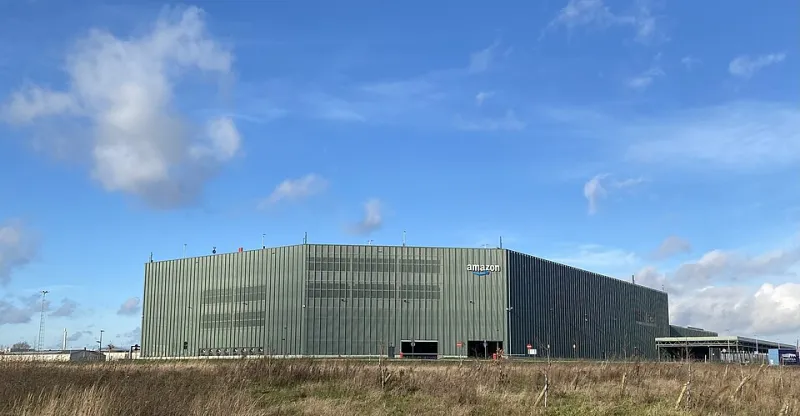
Photo: Lodevermeiren, CC BY-SA 4.0, via Wikimedia Commons
Walk the floor of a modern distribution center — whether it's a 1.2 million square foot facility off I-40 outside Memphis or one of the sprawling fulfillment campuses clustered around Allentown, Pennsylvania — and you'll notice something the network diagrams don't capture: the building never stops moving. Autonomous mobile robots cross aisles at speed. Forklifts stream telemetry from twenty feet up a rack. Barcode scanners, wearable terminals, and IoT sensors all compete for the same airwaves.
For years, the answer to that congestion problem was more Wi-Fi — more access points, more cabling, more overlap. That era may be ending. Across American logistics, operations leaders are increasingly asking their network teams about private 5G: cellular-grade coverage they own outright, managed not through a carrier's core but through their own SDN controllers. And when that conversation starts, network architects need to be ready, because the tradeoffs are real.
Why Wi-Fi Struggles at Warehouse Scale
The core problem is deterministic behavior. Wi-Fi was never designed to guarantee handoff quality for a robot traveling at 15 miles per hour across a million square feet. Client-side steering means the device — not the network — decides when to roam, and cheap industrial scanners with marginal radios make that decision poorly. In a facility where a dropped packet can stall a pick path or orphan a robot's task assignment, "best effort" becomes an operational liability.
High-bay racking compounds the issue. Racks stacked 40 feet high create dense metal canyons that scatter 2.4 GHz and 5 GHz signals unpredictably. Getting reliable coverage often means mounting access points on the rack structure itself — which means running Cat6a cable up the steel, at height, in an environment where every cable drop is a labor cost and a future maintenance call.
Private 5G inverts that math. A handful of small cells, often mounted on the ceiling structure or walls, can blanket enormous open volumes. And because the network controls handoff decisions rather than the client, roaming behavior becomes predictable — something robot fleet software vendors have been quietly requesting for years.
The SDN Controller Is the Actual Product
Here's what the vendor pitches tend to bury: the radio access network is the easy part. What makes private 5G workable for an enterprise is the control plane, and that's where software-defined networking earns its keep.
In a well-designed deployment, the SDN controller treats the private 5G network as just another fabric to orchestrate. Traffic from the AMR fleet lands in one network slice; warehouse management systems in another; guest and contractor devices in a third. Policy follows the workload, not the port. When the operations team needs to prioritize robot telemetry during peak season, that's a controller-level change — not a forklift upgrade of switching infrastructure.
This matters because warehouse networks change constantly. Rack layouts get reconfigured. New automation vendors show up mid-contract. A software-defined approach lets the network team absorb those changes without a construction project. Compare that to a traditional wired deployment, where every automation vendor onboarding tends to mean new switch ports, new VLANs, and a change window.
The Cost Question: Copper in the Racking
The honest comparison isn't 5G versus Wi-Fi — it's wireless versus pulling cable through high-bay steel. Network architects should build the business case around a few concrete variables:
- Cable run economics. In a 40-foot rack environment, a single Cat6a drop can cost several hundred dollars once lift equipment, union labor, and downtime windows are counted. Multiply across hundreds of drops and copper gets expensive fast.
- Reconfiguration frequency. If the facility re-slots racking every 18 to 24 months, fixed cabling becomes a recurring cost. Wireless capacity, by contrast, is largely location-independent.
- Device density. Hundreds of AMRs per site change the calculus in favor of licensed-spectrum private 5G, which handles dense mobility far more gracefully than unlicensed bands.
- Spectrum and compliance. CBRS in the US gives enterprises a workable path to private spectrum, but the SAS coordination and device certification requirements aren't free. Budget for them.
In facilities with light automation and stable layouts, Wi-Fi and copper remain the right answer. The case for private 5G strengthens with every robot added to the fleet and every rack reconfiguration on the calendar.
What to Tell Operations When They Come Asking
The request will almost certainly arrive sideways — not from IT, but from an operations VP who saw a demo at MODEX or heard a pitch from their automation vendor. Resist the urge to dismiss it. Instead, ask for specifics: which devices need guaranteed mobility, what roaming latency the robot software actually tolerates, and what the five-year device refresh plan looks like.
Then run a pilot on the hardest 100,000 square feet you have — the densest racking, the fastest robots. Private 5G over a warehouse floor is a solved problem in controlled conditions; the value shows up in the ugly corners. If it performs there, the architecture will scale. If it doesn't, you'll have spent a fraction of the cost to find out before the whole facility depends on it.
The distribution centers being built today in the logistics corridors of Tennessee, Pennsylvania, and Southern California are betting their throughput on wireless mobility. For network architects, the question is no longer whether private 5G belongs in the warehouse — it's whether you'll be the one who designs it, or the one who inherits it.