Cutting the Cord Budget: When a New Office Can Skip the Copper Closet Entirely

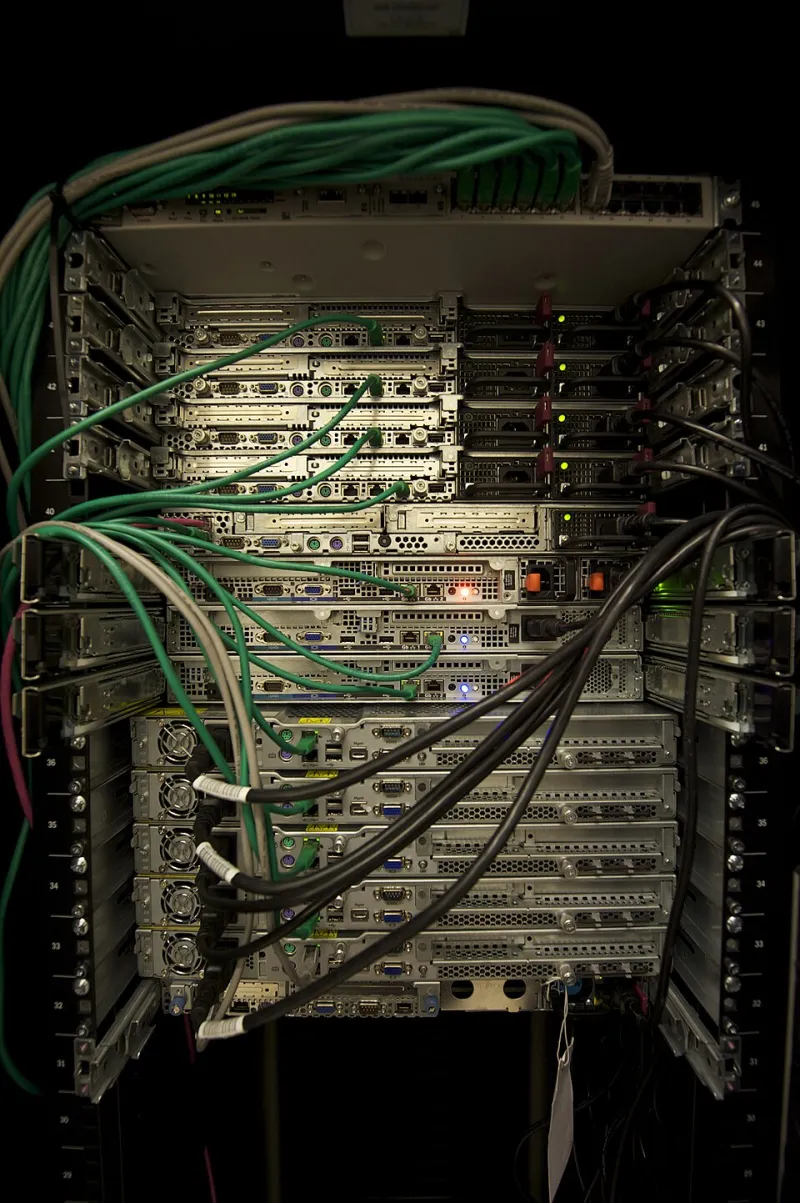
Photo: Unknown authorUnknown author, Public domain, via Wikimedia Commons
Every few years, the networking industry rediscovers the same tempting proposition: what if we just didn't pull the cable? This time the pitch arrives wearing a Wi-Fi 7 badge, backed by multi-gig fixed wireless access and a generation of access points that promise multi-gigabit throughput to every desk, register, and security camera on the floor.
For facilities directors staring at a cabling quote — often $150 to $300 per drop installed in American commercial construction, multiplied across hundreds of drops — the math deserves an honest hearing. But so does the fine print.
The Vendor Case, Taken at Face Value
Talk to the wireless vendors and the argument is coherent. Wi-Fi 7's multi-link operation and 320 MHz channels deliver real multi-gig capacity. Modern APs run on PoE, need exactly one uplink each, and license-based management means a two-person IT shop can run fifty sites from a dashboard. Retail is further along than offices: point-of-sale, kiosk, and inventory tablet workloads were born wireless, and several national chains have already built new stores with a fraction of the drops their 2015-era builds required.
One Midwest regional retailer SDNGNet spoke with reported cutting new-store cabling scope by roughly 60 percent, reserving copper only for APs, cameras, and a handful of wired payment terminals. Their buildout cost per site dropped meaningfully, and their fit-out schedule shortened by weeks — no small thing when every week of construction delay is a week of unpaid lease.
Where the Argument Strains
Now the counterparty's turn. Structured cabling is boring precisely because it is deterministic. A Cat6A drop is a twenty-year asset with a known failure mode and a known fix. Radio spectrum is a shared, unlicensed, adversarial environment. Your Wi-Fi 7 deployment shares 6 GHz with your neighbors' Wi-Fi 7 deployment, and in dense urban cores — think midtown Manhattan or a Dallas medical district — spectrum contention is not a hypothetical.
Then there's the FWA wrinkle. Multi-gig fixed wireless as a primary circuit is genuinely transformative for sites where fiber construction costs $40,000 and takes nine months. But it is still licensed spectrum with carrier-dependent capacity, and most enterprise agreements do not yet carry the SLA weight of a lit fiber service. Using FWA as a branch primary with a wireless-only LAN downstream stacks one radio-dependent layer on another. When the weather turns, everything turns with it.
Finally, the hidden costs. Wireless-first buildings still need conduit, AP enclosures, mounting infrastructure, and — critically — more APs than the vendor's coverage model suggests once the furniture, glass, and racking go in. Post-occupancy RF surveys, added APs, and controller license true-ups have a way of eroding the cabling savings that justified the design in the first place.
A Decision Framework for the Build Committee
Neither camp is wrong; they're answering different questions. Before committing either way, score your project against five questions:
- What is your worst-case workload? If it's a nurse workstation pulling imaging files or a design team shuffling gigabyte assets, copper to the desk remains the honest answer. If it's laptops, phones, and tablets, wireless-first is defensible.
- What's your density ceiling? A 40-person office and a 400-person call center have the same square footage problem but opposite answers. Model concurrent clients per AP at peak, not average.
- How radio-hostile is the building? Tilt-up concrete, low-E glass, and dense racking punish RF. Older wood-framed construction is forgiving. Walk the actual building, not the floor plan.
- What does your WAN redundancy look like? Wireless LAN plus fiber primary plus FWA backup is a resilient design. Wireless LAN plus FWA-only is a single point of atmospheric failure.
- Who owns the building for how long? A five-year lease argues for wireless flexibility. A twenty-year owner-occupied headquarters argues for copper as infrastructure, not expense.
The Probably-Right Answer for Most American Sites
The realistic consensus, borne out by what enterprises are actually building: not wireless-first, but wireless-mostly. Eliminate desk drops aggressively. Keep structured cabling for the backbone, APs, cameras, access control, and anything with a compliance or uptime obligation. Treat FWA as a first-class WAN option where fiber economics are hostile, but never as the only path.
The copper closet isn't dead. It's just smaller, cheaper, and finally proportionate to what the building actually needs — which is more than the vendors promised and less than the cabling contractors fear.