The 2 A.M. Fabric: Inside the Networks That Fix Themselves While America Sleeps
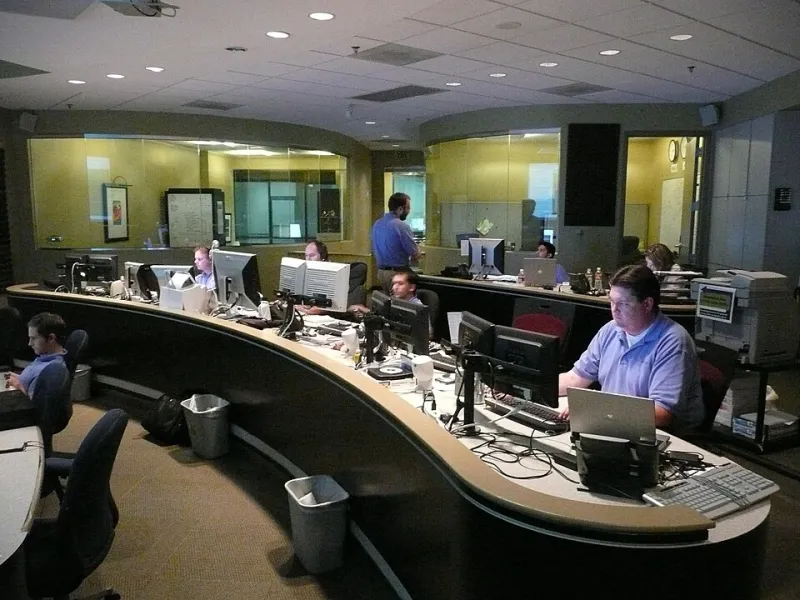
Photo: Mike Reyher, CC BY 2.0, via Wikimedia Commons
Between midnight and 6 a.m., the American enterprise network runs its most unforgiving shift. The hospital in Cleveland is still moving chart data between floors. The regional utility in Nebraska is still polling substation relays. The distribution hub outside Memphis is still pushing tens of thousands of packages through sorting logic that depends on a wired and wireless fabric nobody is awake to babysit.
This is the paradox of the modern overnight network: the tolerance for failure is at its lowest precisely when the available human expertise is at its thinnest. A skeleton crew — often a single network operations center engineer covering an entire region — cannot run cable, chase a flapping link, or reason through a BGP convergence problem at 2:15 a.m. And so, quietly over the past several years, the industry's answer has been to stop requiring them to.
The Shift Nobody Wants to Work
Talk to veteran NOC engineers and a pattern emerges. A decade ago, the overnight queue was a steady drip of low-grade misery: an access switch hung, a DHCP scope exhausted, a WAN circuit brownout that no one could confirm until the carrier's day shift came online. Each ticket was individually small. Collectively, they meant that the engineer on duty spent the night reacting rather than verifying.
That workload profile is exactly what software-defined networking was built to collapse. When forwarding decisions are abstracted from a central controller, and when policy is expressed as intent — "clinical VLAN traffic must always reach the EHR segment with sub-50ms failover" — the network itself becomes the first responder. The controller detects the degraded link, reroutes around it, and logs the event for the morning crew. The ticket that would have woken someone up in 2015 simply never becomes a ticket at all.
Self-Healing Is a Design Choice, Not a Feature Toggle
It's worth being precise about what "self-healing" actually means, because vendors use the phrase loosely. In practice, overnight resilience rests on three layers that must be designed together.
First, automated failover at the transport layer. Redundant uplinks, dual paths to the core, and protocols that converge in milliseconds rather than seconds. This is table stakes, but it only works if the failover paths are genuinely independent — a lesson organizations relearn every time a single conduit cut takes out what was sold as redundancy.
Second, closed-loop remediation at the controller layer. This is where SDN earns its keep. Modern fabrics continuously verify that the operational state matches declared intent. When they diverge — a port flapping, a policy misapplied after a device reboots — the controller can isolate the fault domain and re-derive the correct state automatically. In well-run environments, the remediation happens before any human notices a symptom.
Third, automated escalation with honest thresholds. Self-healing networks fail too, and the mark of a mature deployment is knowing when to give up gracefully. A fabric that silently thrashes on a problem for four hours is worse than one that pages a human after fifteen minutes with a clean diagnostic summary attached.
One Engineer's Quiet Night
Consider a composite drawn from conversations with operations teams across the Midwest: a NOC engineer we'll call Dana, responsible for monitoring the network estate of a mid-sized regional health system — six hospitals, dozens of clinics, and a data center that never sleeps.
Three years ago, Dana's overnight log averaged forty-plus events per shift. Most were benign, but each demanded triage: was the MRI suite's VLAN actually down, or was it a stale SNMP poll? Was the clinic in the next state offline, or just its monitoring probe? The cognitive load wasn't the outages; it was the constant triage of ambiguity.
After a staged migration to an intent-based fabric — policy templates pushed from a central controller, telemetry streamed back in real time — that log now averages fewer than ten events, and the ones that remain arrive with context: affected segment, likely cause, suggested action, blast radius. Dana estimates the 2 a.m. workload has dropped roughly 80 percent. The night shift went from firefighting to supervision. "I read the morning's automation report with my coffee," Dana says. "I don't remember the last time I dialed into a switch before sunrise."
When the Machines Get It Wrong
The honest counterweight is that automation failures are louder than manual ones. A human who misdiagnoses a problem usually fails slowly and visibly. A controller acting on bad telemetry can fail fast and confidently — rerouting traffic into a path that's congested, or applying a remediation policy that conflicts with a compliance rule nobody encoded.
The teams that run overnight automation successfully share a few habits. They rehearse failure deliberately, injecting link faults during controlled windows to confirm the fabric behaves as intended. They keep the intent definitions under the same change-control discipline as firewall rules, because a stale policy is a latent outage. And they resist the temptation to let automation paper over root causes — a self-healing network that masks a dying fiber run for eight months hasn't solved the problem; it has scheduled it.
The Morning Report as the New Deliverable
There's a cultural shift hiding inside the technical one. The overnight NOC's output used to be measured in tickets closed. Increasingly, it's measured in tickets that never opened — and in the quality of the automated summary waiting on the day shift's desk: what the fabric changed, why, what it couldn't fix, and what deserves a human's attention before the next nightfall.
For American enterprises running around-the-clock operations, that's the real promise of software-defined networking. Not a network with no engineers, but a network where the engineer at 2 a.m. is a supervisor of systems that diagnose and repair themselves — and where the rare escalation that does come through is worth waking up for.